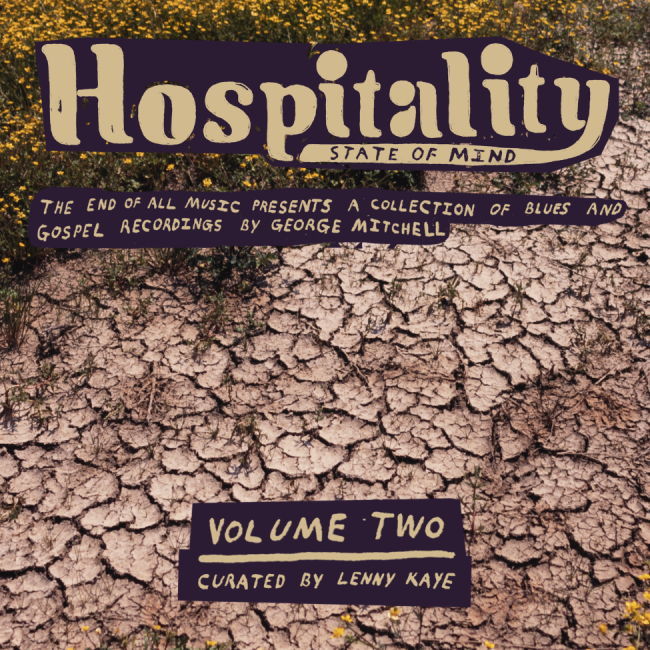
“Hospitality State of Mind” is a collection of blues and gospel recordings by George Mitchell. Volume two was curated by Lenny Kaye.
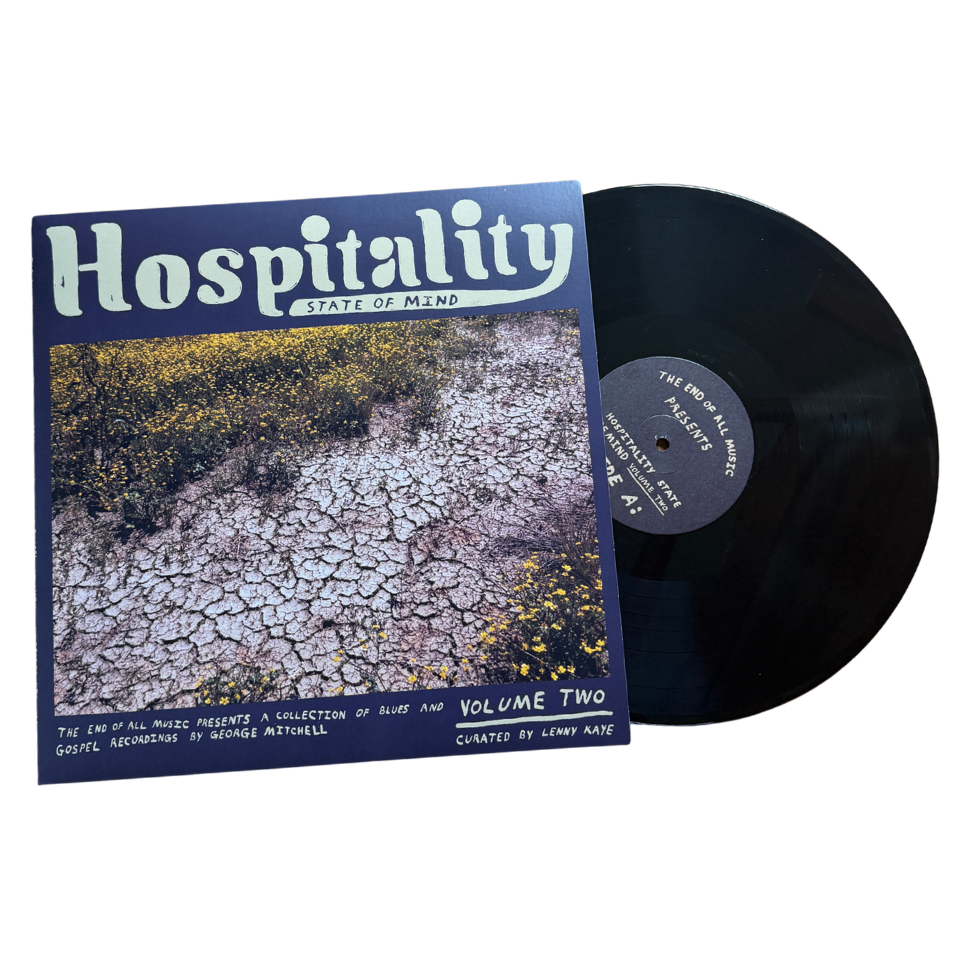
Available at The End of All Music in Oxford and Jackson, Mississippi.
AVAILABLE ONLINE HERE.
All tracks are part of the George Mitchell Collection and are licensed by Fat Possum Records.
The record features songs by Houston Stackhouse, John Lee Ziegler, Lonzie Thomas, Green Pachal, Bud Grant, Robert “Nighthawk” Johnson, Bud White, Jim Bunkley, Robert Longstreet, George Henry Bussey, James Davis, and the Pettis Sisters.
Song selection by Lenny Kaye.
The cover photograph is by Jane Rule Burdine.
The font and layout is by J. Burwell.
Limited to 1000 copies. Pressed in Memphis at Memphis Record Pressing.
The record includes 12 tracks of blues and gospel field recordings made by George Mitchell throughout the 1960’s through the 1980’s. These recordings were collected on Mitchell’s trips throughout the deep south searching for authentic blues musicians in their homes and workplaces.
Earlier this year, we sent the entire George Mitchell Collection to Lenny Kaye and told him to pick his favorites resulting in this new volume. The first volume in this series was released in 2020 and is now sold out. Read more about George Mitchell and see his photographs here.
This release is also the RECORD OF THE MONTH CLUB pick for July. Club Members will be getting a copy of the LP + the summer issue of Southwest Review featuring more of Jane Rule Burdine’s photographs.
If any record shops would like to purchase wholesale copies please email us at endofallmusic@gmail.com.
RECORD RELEASE PARTY: Thursday, July 9th at Wonderbird Distillery in Taylor, Mississippi at 6 p.m. We’ll be playing the record and drinking cocktails. Copies will be for sale. Jane Rule Burdine will be hanging out and chatting about her work. Copies of Southwest Review will also be available.
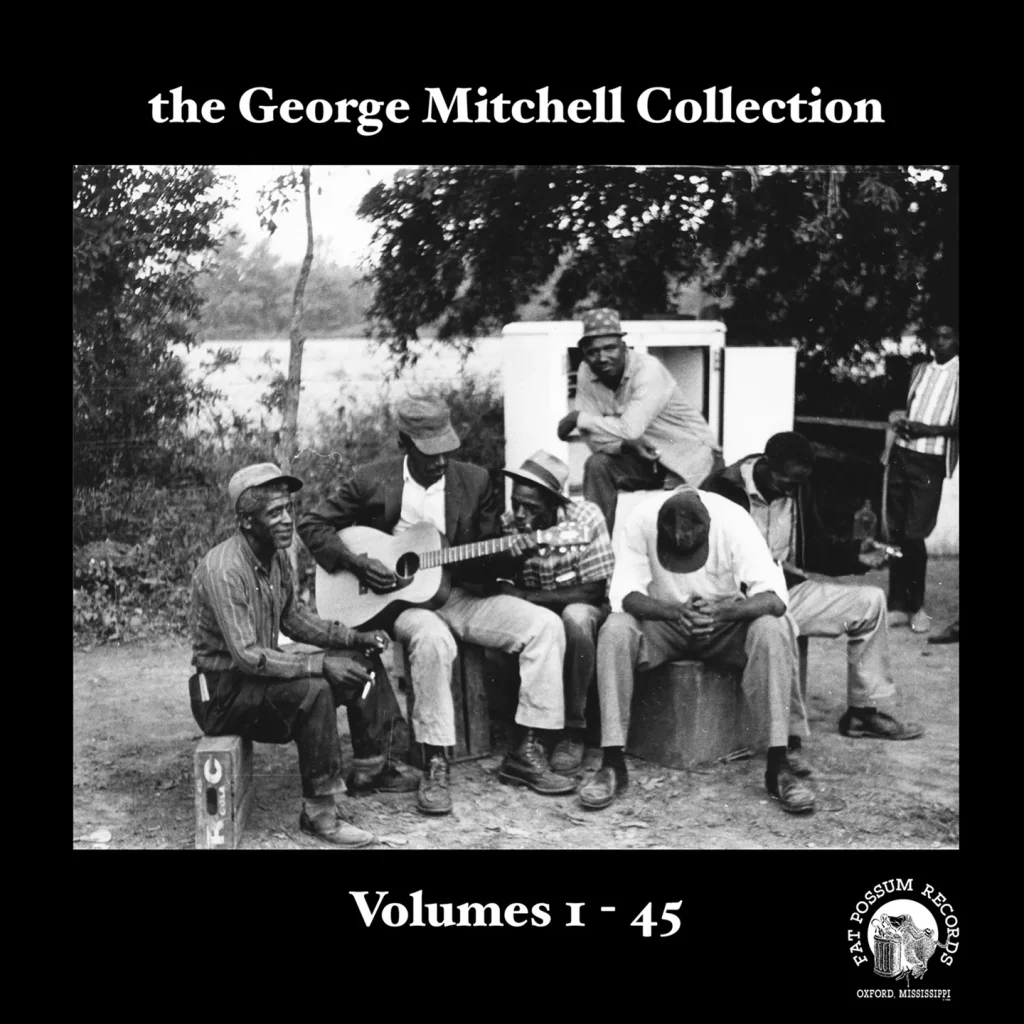
“Another rainy morning, deep into a season of feeling underwater — utterly perfect soundtrack, humid & raw, courtesy of @endofallmusic & the legend @lenny_kaye. Culled from the vast & steamy collection of George Mitchell, the ad-hoc blues historian who started making field recordings around the South (& in the hill country of north Mississippi, in particular) in the 1960s. Back in 2008, @fatpossum put out a 45-volume (!) collection pulled from his archives, & ofc it is awesome & overwhelming; for this LP, Lenny gathered a hot dozen. Probably some of the most charged & glowing performances I’ve ever heard. Easy to blather on about the humanity of a record like this — a little portal to elsewhere, art fully untethered from commerce & perhaps even time! Gorgeous, weird. As Lenny writes, it’s a minor miracle these songs exist on record at all — they “needed preservation before vanishing into the air, the threnody of the hill country. Home blues, as it were, and always will be.” No misses here, but if you’re looking to vibrate out-of-body for a bit, I’d recommend cuing up John Lee Ziegler’s “Who’s Gonna Be Your Man” — Ziegler, who was born in 1929, supposedly played the acoustic guitar left-handed and upside-down. Loamy falsetto. Some unnamed fellow is ripping it up on the spoons. Kids hooting in the background. A flawless performance, in my opinion — celestial & reaching. God bless anybody who gives enough of a shit to not let this music disappear 🙏” – Amanda Petrusich
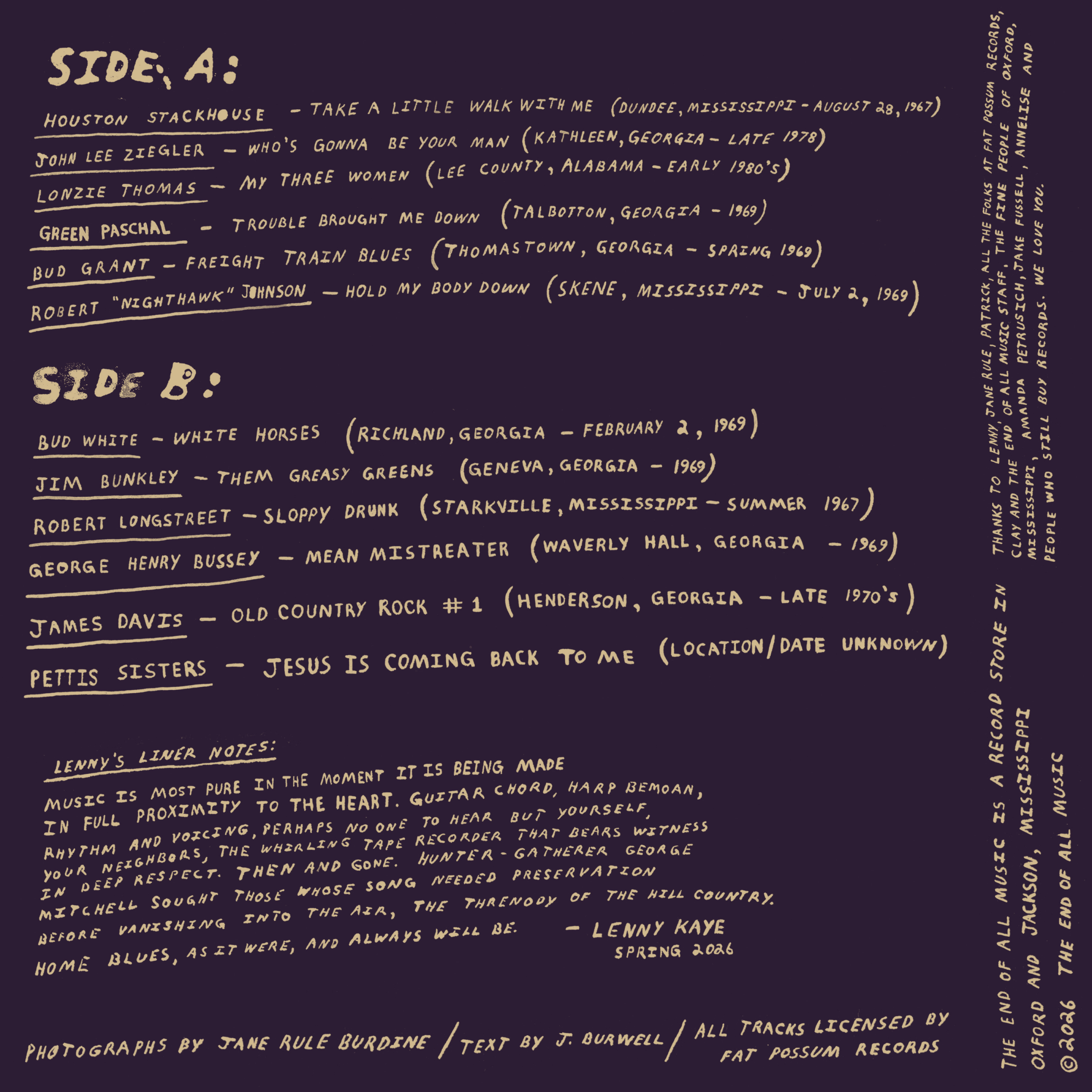
Lenny’s liner notes:
Music is most pure in the moment it is being made, in full proximity to the heart. Guitar chord, harp bemoan, rhythm and voicing, perhaps no one to hear but yourself, your neighbors, the whirling tape recorder that bears witness in deep respect. Then and gone. Hunter-gatherer George Mitchell sought those whose song needed preservation before vanishing into the air, the threnody of the Hill Country. Home Blues, as it were, and always will be.
Song selection by Lenny Kaye
Lenny Kaye is a guitarist, music journalist, and record producer. He is the longtime lead guitarist for the Patti Smith Group, as well as the compiler of the seminal 1972 garage rock anthology Nuggets: Original Artyfacts From the First Psychedelic Era 1965-1968. Lenny’s first solo album, Goin’ Local, is out now via Yep Roc Records.
Cover photo by Jane Rule Burdine
Mississippi Delta native Jane Rule Burdine is a photographer and University of Mississippi alumna. A freelance photographer since the 1970s, her work is widely exhibited. She was the subject of the 2018 documentary Under Her Skin and her monograph, Delta Deep Down, was published by the University Press of Mississippi. She currently lives in Taylor, Mississippi.
Text and layout design by J. Burwell
Josh Burwell is a Mississippi-born artist and illustrator living in Los Angeles, California. His work has appeared numerous times at The End of All Music since 2012. He’s a great pal.
About the performers on the album:
Houston Stackhouse
Born in Wesson, MS, in 1918, Houston Stackhouse’s first instrument was the harmonica. Throughout the 1930s Stackhouse played around Mississippi with the Mississippi Sheiks and Robert Johnson. Stackhouse taught the slide guitar to his cousin, Robert Nighthawk, and the two would play together on Mother’s Best Flower Hour and the King Biscuit Time show, both broadcast on KFFA in Helena, AR. Playing on KFFA, Stackhouse was brought into contact with James Elmore, Muddy Waters, Little Walter, Jimmy Rogers, Roosevelt Sykes and Earl Hooker. Electric guitar became Stackhouse’s full-time instrument.
John Lee Zeigler
John Lee Zeigler, from Kathleen, Georgia, was a unique blues stylist who taught himself to play the guitar left-handed and upside-down using a custom copper tubing slide. Raised working in farm fields, he spent decades performing at local house parties and fish fries while working a 38-year career as a self-taught plumber. His distinctive ear-trained playing style, characterized by inverted bass strings and original chords that others struggled to replicate, is preserved alongside other traditional American roots musicians by the Music Maker Foundation.
Lonzie Thomas
Born in 1921 in Lee County, Alabama, country blues musician Lonzie Thomas taught himself to play guitar by mirroring his father’s finger placements. After being tragically blinded at age 22, he turned to music as a livelihood, performing for tips at local house parties and on city streets. His raw, expressive acoustic style was later captured in the field by blues researcher George Mitchell, resulting in authentic recordings like “My Three Women Now” that are preserved today as vital pieces of traditional American blues.
Green Paschal
Born around 1927 in Talbotton, Georgia, Green Paschal was a deeply expressive musician who transitioned from playing secular country blues to traditional gospel in the mid-1950s. His raw, acoustic track “Trouble Brought Me Down” was recorded in the field by blues researcher George Mitchell in 1969. Evoking the deep hardships and spiritual resilience of the rural South, Paschal’s traditional style was later preserved and widely introduced to audiences through the 2008 release of The George Mitchell Collection.
Buck Grant
Often credited as Bud Grant, rural bluesman Buck Grant was an acoustic guitar player and singer known for his traditional, steady-driving style. In the late 1960s, blues researcher George Mitchell traveled the American South and captured Grant’s raw performances in the field. His standout track “Freight Train Blues”—alongside numbers like “Rock Me Mama”—vividly channels the rhythmic imagery of the railroad. Originally cut during Mitchell’s field trips, Grant’s rare recordings were officially compiled and released in 2007 on The George Mitchell Collection, preserving his distinct voice within the fabric of early country blues.
Robert Johnson
Often confused with his legendary 1930s namesake, this Robert Johnson was an entirely different Mississippi Delta blues and gospel musician born in 1916 in Louisiana. On July 2, 1969, blues researcher George Mitchell visited Johnson’s home near Cleveland, Mississippi, to capture his raw, rural sound. Accompanied by the vocals of his family members Norma, Dorothy, and Shirley, Johnson recorded the powerful, mournful track “Hold My Body Down” (frequently compiled as “Hold My Baby Down”). The track stands as an authentic slice of front-porch gospel-blues, later preserved and issued worldwide on the 2008 box set The George Mitchell Collection.
Bud White
A traditional Georgia country bluesman, Bud White learned much of his repertoire from traveling musicians who passed through the region. On February 2, 1969, blues researcher George Mitchell tracked him down in Richland, Georgia, capturing his raw acoustic vocals and guitar work in a makeshift home recording session. White’s standout track “White Horses” (also known as “16 Snow White Horses”) delivers a driving, rhythmic folk-blues narrative. Initially issued on a rare 7-inch vinyl, his sessions were later compiled and released in 2008 on The George Mitchell Collection, cementing White’s place as a vital voice of regional Southern blues.
Jim Buckley
Often credited on modern compilations as “Jim Buckley,” Jim Bunkley was a traditional country bluesman born in Talbot County, Georgia. He grew up in a deeply musical family and learned to play guitar at age eight by sneaking his brothers’ instrument off the wall, teaching himself by mimicking old Blind Lemon Jefferson records. In 1969, blues researcher George Mitchell traveled to Geneva, Georgia, to capture Bunkley’s exceptional slide work and rhythmic acoustic style, including the lively folk-blues track “Them Greasy Greens.” Sadly, Bunkley was killed in a car accident shortly before his field sessions were originally scheduled for release, leaving tracks like “Greasy Greens” to be preserved and widely shared on the 2008 box set The George Mitchell Collection.
Robert Longstreet
An obscure figure documented during the peak of 1960s regional field recordings, country bluesman Robert Longstreet brought a raw, vocal-and-harmonica style to the Southern blues tradition. Captured in the field by researcher George Mitchell, Longstreet’s standout track “Sloppy Drunk” features his gritty vocals paired with a driving harmonica arrangement that honors the foundational themes of standard delta and country blues. His rare, unvarnished field sessions were eventually given a wide audience through the 2008 release of The George Mitchell Collection (Volume 28), preserving his unique, energetic porch-style acoustic sound.
George Henry Bussey
An acoustic country bluesman from the rural South, George Henry Bussey was known for a soulful, nasal vocal delivery paired with steady, major-key guitar picking. In 1969, blues researcher George Mitchell captured Bussey’s authentic regional sound during field recording trips through Georgia. His standout performance on “Mean Mistreater” (sometimes compiled as “Mean Mistreated”) captures his vocals at their most alive and emotive. Originally released on a joint LP with fellow bluesman Jim Bunkley in 1971, Bussey’s tracks were later introduced to wider audiences through the 2007 box set The George Mitchell Collection.
James Davis
Electric blues guitarist James Davis (1931–2007) was a prominent figure in the post-war music scene of Perry, Georgia, known for his driving rhythms and his signature song “Georgia Drumbeat.” In the late 20th century, blues researcher George Mitchell captured his raw, unfiltered talent during his field recording expeditions, highlighting Davis’s skill at bridging rural acoustic foundations with electrified styles. His standout instrumental track “Old Country Rock #1” (frequently compiled as “Old Country Road #1”) acts as a hypnotic showcase of his rhythmic picking, later preserved and introduced to wider audiences on the 2008 box set The George Mitchell Collection (Volume 43).
The Pettis Sisters
The Pettis Sisters—a gospel group composed of sisters Marie, Jimmie, and Brenda Pettis—grew up singing in the rural churches of east Alabama and western Georgia. In 1969, blues researcher George Mitchell captured their powerful, raw harmonies during his field recording trips through the region, documenting a vibrant slice of unpolished, small-church African American spiritual music. Their standout a cappella performance, “Jesus Is Coming Back To Me,” showcases their driving rhythm and emotional vocal interplay. The track was later preserved and introduced to wider audiences through the 2008 box set release of The George Mitchell Collection.
You can hear more of the George Mitchell Collection over at Fat Possum Records.